
Did you know that film rolls were the key to both Kodak’s rise and eventual downfall? For over a century, our fathers and forefathers captured their most treasured moments—from childhood to marriage—using Kodak film cameras. But today, we rely on smartphones and digital cameras instead. So, how did this shift happen, and what led to the decline of film-based photography? Let’s explore the rise of digital cameras and the fall of Kodak and film-based picture taking.
Table of Content
Kodak’s Early Days
George Eastman founded Kodak in 1888 to simplify taking pictures and make it widely accessible for all. His efforts turned the photography industry from the old-fashioned camera that stood on a four-wooden leg into the nice Brownie 127, the most popular camera Kodak ever made. Kodak enjoyed fame, popularity, and market dominance for over 10 decades. During its journey, the company received early warnings to shift its strategy; however, Kodak turned a blind eye to technological advancements.
When Steve Sasson, a Kodak engineer invented a digital camera in 1975, Kodak resisted this invention and said it is “filmless.” “Kodak ignored digital cameras because the business of films and paper was very profitable at that time.” However, they did not see opportunities beyond their times!
Early Warnings for Kodak
Years later in 2006, Dr. Kamal Munir alarmed the company that today’s customers’ preferences have changed. They no longer ‘preserve memories’ on a piece of paper; rather they ‘share memories’ electronically via email and on Facebook. However, with all of these warnings, Kodak did not fully embrace technological changes.
The real problem for Kodak appeared when companies began to merge cameras with smartphones and people started to share pictures online. It was too late for Kodak to stop selling traditional cameras and invest in digital cameras because competitors already advanced in the market. That is how Kodak was left behind. This failure left historic economic impacts on the industry. From 1994 up to 2010, sales of film rolls and analog cameras declined sharply; while sales of digital cameras boosted dramatically.
Figure 1: Film vs. Digital Camera Sales
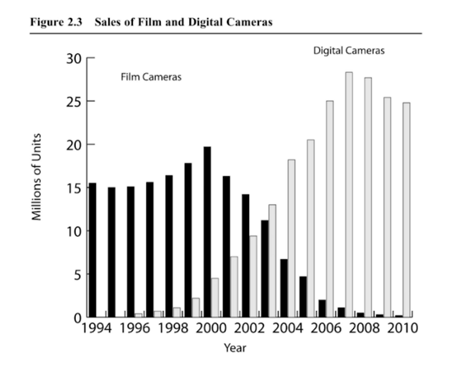
Source: Search for Survival: Lessons from Disruptive Technologies.
Meanwhile, the number of Kodak’s employees from 60,000 in 1980’s decreased to 10,000 in 2012. The stock price from nearly $100 fell to $0.54 per share.
Figure 2: Price Share
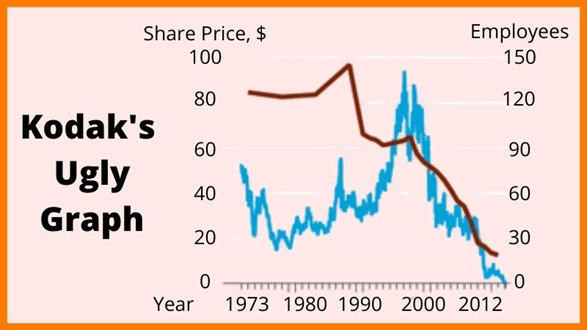
Source: Bloomberg Originals, a YouTube channel
Figure 3: Employee Downfall
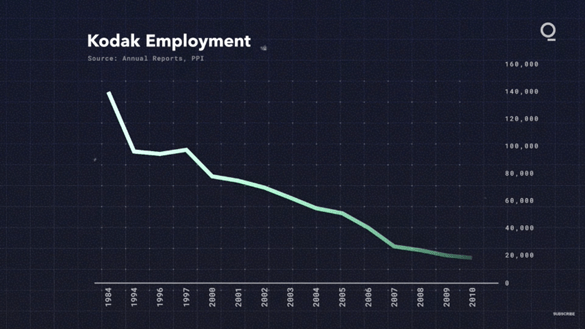
Source: Kounteyo Roychowdhury (2019)
And this is how it’s net sales dropped. Boom.
Figure 4: Net Sales
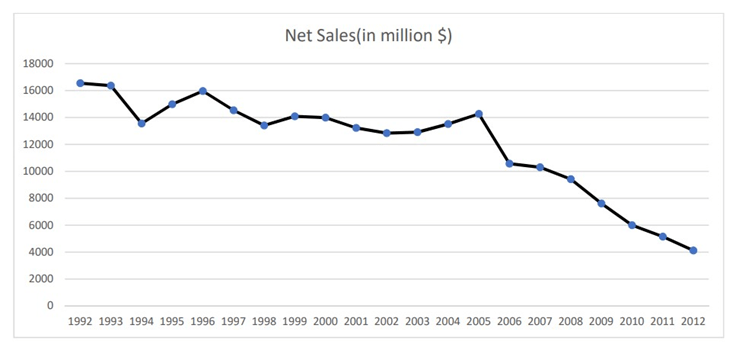
Source: Kounteyo Roychowdhury (2019)
Kodak Missed the Opportunity
Kodak could have invested in the digital camera technology invented by its own engineer, a move that could have allowed the company to dominate the photography world for yet another century. However, the company’s sluggish attitude and reluctance to shift from its profitable film business ultimately held it back. By failing to adapt, Kodak missed the chance to lead the digital revolution and was overtaken by faster-moving competitors.

Although Kodak died, people did not stop recording the best moments of their lives and memories. They began to use digital cameras and smartphones to treasure the best moments of their lives. Kodak’s failure not only affected its employees but also impacted people around the world. Kodak was part of everyone’s lives from childhood to marriage to treasure their best moments of life. It remained part of our life for more than a century. But, it’s no longer with us, fading from our lives after more than a century.
Conclusion
In short, for over a century, Kodak completely owned the film and picture industry. However, with the advent of digital photography, Kodak began to fail. Kodak failed because it simply lacked innovation and did not adapt to changes. Kodak hesitated to embrace the digital camera, even though it was invented by its own engineer, Steve Sasson.
The management said it is ‘filmless,’ but they were unaware that this film-based photography, which once drove the company’s growth for a century, would also lead to its collapse. And it did. After 130 years of service, Kodak filed for bankruptcy on January 19, 2012, and said goodbye to all its customers. This is how the era of the famous slogan, “You push the button, we do the rest” came to an end.
References
- Bloomberg Originals [Username]. (2020, Nov 19). The Rise and Fall…and Rise of Kodak. [Video]. YouTube. https://www.youtube.com/watch?v=u7yo7e3HhKA
- Company Man [Username]. (2018, Jun 18). The Decline of Kodak…What Happened? [Video]. YouTube. https://www.youtube.com/watch?v=eVrmFgvEnAA
- Roychowdhury, K. (2019). A case study on kodak downfall. Researchgate. https://www.researchgate.net/publication/336613727_A_case_study_on_kodak_downfallpdf
- Mui, C. (2012). How Kodak Failed. Forbes. https://www.forbes.com/sites/microsoft_/2023/05/08/ai-and-predictive-analytics-moving-from-insights-to-foresight/?sh=3c58e8a93e98
- The rise and fall of Kodak’s moment. (2012). Cambridge University. Retrieved on May 26, 2023 from https://www.cam.ac.uk/research/news/the-rise-and-fall-of-kodaks-moment
- Yash Taneja, Y. [Uploader] (2021). Why Did Kodak Fail? Kodak Bankruptcy Case Study. Startup Talky. https://startuptalky.com/kodak-bankruptcy-case-study/
 Moallifeen Blogging Services
Leave a comment