

Author-Date Style
An in-text citation credits the source within your writing by including the author’s name and publication year. APA is author-date style of citation, which means for every source to cite, you will need author’s last name and the year of publication. Author’s first name, month and day of publication are not used in the in-text citation. In-text citation can be writher narrative or parenthetical.
Narrative citation: According to Parada (2021), mutual obligation, trust, and respect strengthen family bonds and drive business growth. Look at how the comma is used after the bracket.
Parenthetical citation: Mutual obligation, trust, and respect strengthen family bonds and drive business growth (Parada, 2021). Note that a period is followed after the bracket.
Outline
Short Quotation
“We are on the road for democracy and justice” (Sanders, 2025).
- Quotations fewer than 40 words are considered short.
- Use quotation marks.
- Include a page number. What if a source does not have a page number? Check out Sources without a Page Number for guidance.
- If you add a word or a phrase to the quotation, use [ ]
- If you remove a word or phrase from the quotation, use ….
Long Quotation
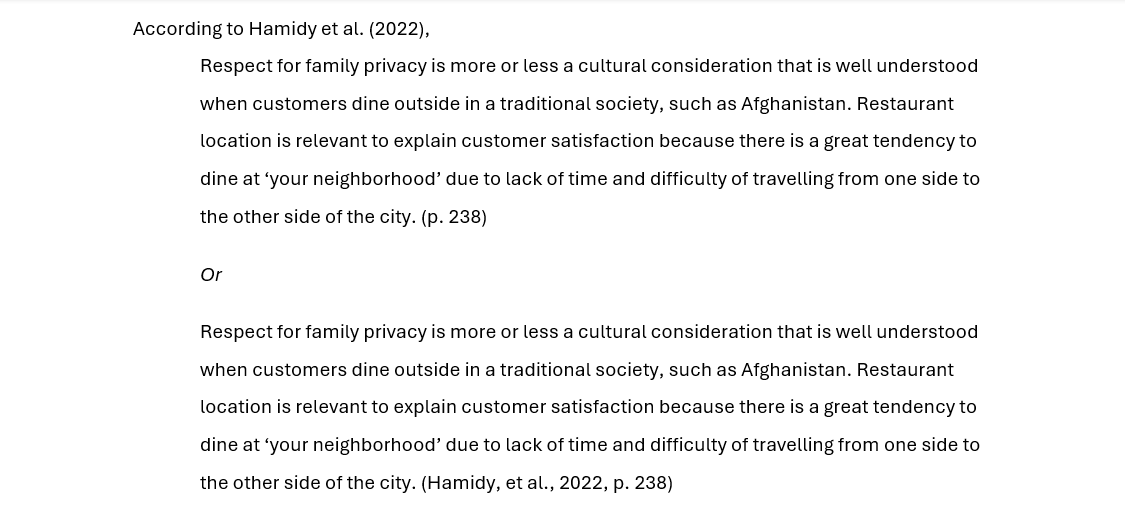
- Quotations more than 40 words are considered long.
- Do not use quotation marks.
- Put the period after the quoted material, not after the bracket.
Paraphrase
Americans are committed to advancing justice and democracy (Sanders, 2025).
- Always paraphrase and minimize direct quote.
- If you write an entire paragraph from a single source, cite it only once. If ideas from the source continues to a new paragraph, cite it again in the new paragraph.
- A page number is not required but helpful to include.
- Place the page number in a parenthesis at the end.
Summary
Sanders (2025) emphasizes that Americans value justice and democracy.
- Follow guidelines for paraphrase.
Three or More Authors
For a source with three or more authors, use the first author’s last name followed by et al.
If you cannot balance family and business responsibilities, it can hurt your company’s performance (Memili, et al., 2012).
Unknown Author
If the source has no author, use
A. Complete Title of the Article: The title of the article in the signal phrase within the quotation marks.
According to “International Migration” (n.d.), an article by the United Nation, “an international migrant …[is a] person who has changed his or her country of residence.”
B. Short Form of the Article: In the parenthetical citation, use short form of the article.
“An international migrant …[is a] person who has changed his or her country of residence” (“Migration”, n.d.).
C. Organization: Use the organization as an author.
The United Nations (n.d.) defines an international migrant as a “person who has changed his or her country of residence.”
Indirect Source
An indirect source is when you cite information that was originally found in one source but is mentioned in another source you are reading. Instead of accessing the original work, you are relying on a second-hand reference.
To understand indirect source, consider the following paragraph, written by Cynthia Benzing, Hung Manh Chu, and Orhan Kara in (2009) and found in page 5891.
“In Europe, 99.8 percent of the business enterprises are small and medium-sized enterprises (SMEs) that employ two thirds of the total workforce (World Bank, 2007). Japan has 6 million SMEs that account for 99.7 percent of all businesses in the country and 70 percent of the total labor force (METI, 2007).”
As you can see, these authors have used ideas from the (World Bank, 2007) and (METI, 2007). World Bank and METI are considered the original sources, and Benzing et al. (2009) is the actual source you are reading.
Here is how you cite this.
Use the original source, in this case the World Bank, in the signal phrase, and cite the source you are reading in the parenthesis.
According to World Bank (2007), nearly all businesses in Europe are SMEs that “employ two thirds of the total workforce” (Benzing, at al., 2009, p. 5891).
Sources without a Page Number
If you are required to use a page number, but you are using online articles that often do not have a page number, there are three alternative ways to replace a page number.
A. Use Paragraph Number: Use a paragraph number instead. Count the paragraphs even if the paragraphs are not numbered.
According to UN (n.d.), “today, more people than ever live in a country other than the one in which they were born” (para. 2).
B. State the Section: Write the section in which the cited information appears.
The United Nations (n.d.) defines an international migrant as a “person who has changed his or her country of residence” (Who is an international migrant? section, para. 1).
C. Include Table or Figure Number: Write the table or figure number from which you cite.
A meta-analysis of available literature (Jones, 1998) revealed inconsistency across large-scale studies of student learning (Table 3).
Multiple Sources
When citing multiple sources in one citation, they are listed in alphabetical order and separated by semicolons within the same set of parentheses. Commonly, multiple sources are used in parenthesis.
Customers can affect one another either directly or indirectly (Baker, 1987; Bitner, 1992). For example, crowding or standing too close to others can create anxiety (Batson & Hui, 1986; Fisher & Brtne, 1975; Hall, 1966).
 Moallifeen Blogging Services
Leave a comment