

An annotated bibliography is a list of sources accompanied by a brief explanation, which is also called an annotation. This annotation summarizes the source, evaluates its credibility, and explains its relevance to a research topic.
An annotated bibliography
a) highlights a key summary of the entire article,
b) explains why the source is credible and appropriate for your research, and
c) describes how the source helps researchers with their own work.
Students and researchers need to prepare the annotated bibliography to assess the quality and usefulness of different sources for their research topic before writing their actual research.
Outline
What is the Purpose of Annotated bibliography?
An annotated bibliography serves multiple purposes in the research process. Some of the key purposes include:
- Summarizing sources – Gives a short summary of the main points and arguments in each source. This helps researchers quickly understand the focus of each source and how it relates to their topic.
- Assessing credibility – Evaluates the reliability, accuracy, and authority of each source to determine its trustworthiness, which ensures that only high-quality and credible sources are used in research.
- Determining relevance –Explains how each source contributes to the research topic and clarifies whether the source supports, challenges, or adds new perspectives to the research topic. The goal is that researchers should understand how the sources at hand fits into their overall study.
- Identifying research gaps – Highlights gaps in the current research and points out areas that need further investigation. This helps students identify topics that have not been explored or areas that require further attention in existing research.
- Organizing research – Helps organize the literature review by categorizing sources, which makes the writing process more efficient.
- Identifying source types – Shows what types of sources such as journal articles, books, websites are available on the topic.
- Showing research understanding – Reflects how well the researcher has engaged with and understand the literature.
How is Annotated Bibliography Written?
An annotated bibliography follows a structure that typically includes the following elements:
- Reference
- Summary
- Assess
- Reflect
1. Reference
Include the reference of the source in the required style. For APA 7th edition, check this guide.
2. Summary
You will need to summarize the key elements of the source, usually found in the abstract or executive summary. Your summary should
- Highlight the main purpose of the research: Explain the central goal or aim of the study and why the research was conducted.
- Identify the research question or objectives: Identify the main question or research objectives of the paper.
- Explain the methodology: Describe the research methodology and explain the research tools utilized in the study.
- Outline major findings: Summarize the key results of the research.
- State the conclusion: Provide a brief summary of the research’s conclusions, including any implications or suggestions for further study.
Note: While including each point is not mandatory, it is highly helpful to include as many of the above elements as possible when summarizing the research article.
3. Assessment
Write one short paragraph that explains why you believe the source is credible
and appropriate. Usually, you can do this by looking at the source itself, and the author’s background.
A. Source Credibility
To check the credibility of a source, consider the following key factors:
- Facts vs. Opinions: Identify whether the source presents facts or personal opinions. Factual information is typically more reliable and appropriate for academic research.
- Reliability of Information: Assess whether the information is credible. Check if the source comes from a journal, a website, a well-known academic publisher, institutions, or government websites. Ensure the source is supported by credible evidence, like data, studies from experts in the field.
- Bias vs. Objectivity: Determine if the source is biased or objective. Objective sources present information fairly, while biased sources reflects the selective presentation of facts or information.
- Usefulness: Consider the usefulness of the source to your research topic. A useful source contributes valuable insights, data, or arguments that support your research.
- Comparison with Other Sources: Evaluate how the source compares to others in your bibliography. Does it offer unique perspectives, reinforce existing knowledge, or fill gaps in the research?
- Type of Source: Understand the type of source you are working with. Academic journals are typically peer-reviewed and offer authoritative, well-researched information. Non-academic sources, such as news articles or blogs, may lack this level of credibility.
B. Author Profile
To assess the crebility of an author, consider their expertise, qualifications, and professional background.
- Academic Background: Review the author’s education and career history to understand their qualifications and expertise in the field.
- Citations and Influence: Check how often the author’s work has been cited in other academic research. High citation counts may indicate their work is influential.
- Awards or Recognition: Look for any awards, honors, or recognition the author has received, which may highlight their contributions to the field.
- Current Role or Position: Consider the author’s current role, such as their position at a university or research organization, which can reflect their credibility in the field.
4. Reflection
Explain how the source is helping you with your own research. In other words, give reasons why the source is helpful to your paper. Pay attention to the below points while writing.
- How it fits into your research: Explain how the source relates to your research topic and how it supports the overall focus of your work.
- Was this source helpful to you? Discuss whether the source provided valuable information or insights that helped you move forward with your research.
- How does it help you shape your argument? Describe how the source supports or challenges your argument, and how it strengthens your position on the topic.
- Has it changed how you think about your topic? Reflect on whether the source offered a new perspective or changed your approach to the topic.
Useful Sentence Starters for Annotated Bibliography
| Annotated Bibliography Structure | Useful Sentence Starters |
| 1. Reference | It does not require sentence starters. See APA 7th edition for guidance. |
| 2. Summary | This article provides an overview of…This study aims to … This research focuses on… The authors investigate… The main objective of the study is … The research methodology involves… Key findings suggest… |
| 3. Credibility | The source is credible because… The author is an expert in… This publication is known for its … The study has used data from … The study has used primary data … Theories are supported by well-known researchers …. There is a lack of supporting evidence The main limitation of the study is . .. |
| 4. Reflect | This source is helpful because … This article is relevant to my research This study helps me understand … This source provides key insights … The findings from this research will help shape my discussion on… I will use this source to support my argument about… |
Sample Annotated Bibliography
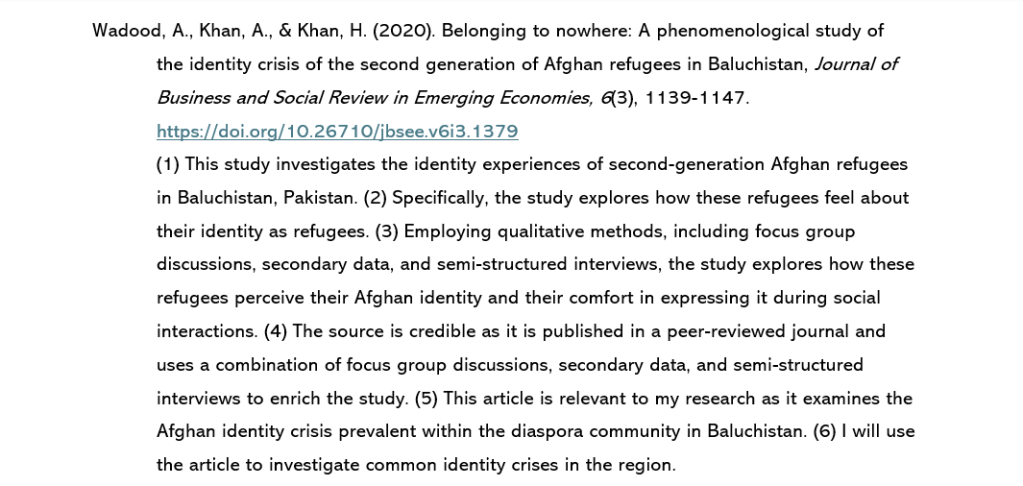
Description: Sentences 1 and 2 highlight the purpose of the research. Sentence 3 explains the methodology and further elaborates on the purpose of the research. Sentence 4 comments on credibility of the source. Sentences 5 and 6 describe how the article is useful for the researcher.
Download the annoated bibliography sample below.
Related Sources
If you are writing your annotaed bibliography, you might also be looking for artificial intelligence content detection tools, paraphrasing tools, humanizers, etc. If so, you might also need to have a look at the below articles.

Enhance Your Research with SciSpace (Typeset)
This article explores how SciSpace can improve the research process by helping researchers save time, reduce frustration, and enhance productivity.

A Review of Top AI Detection Tools
This article describes how QuillBot, Bypass GPT, Undetectable AI, CopyLeaks, and Gemini work to help users humanize AI-generated content.
 Moallifeen Blogging Services
Leave a comment